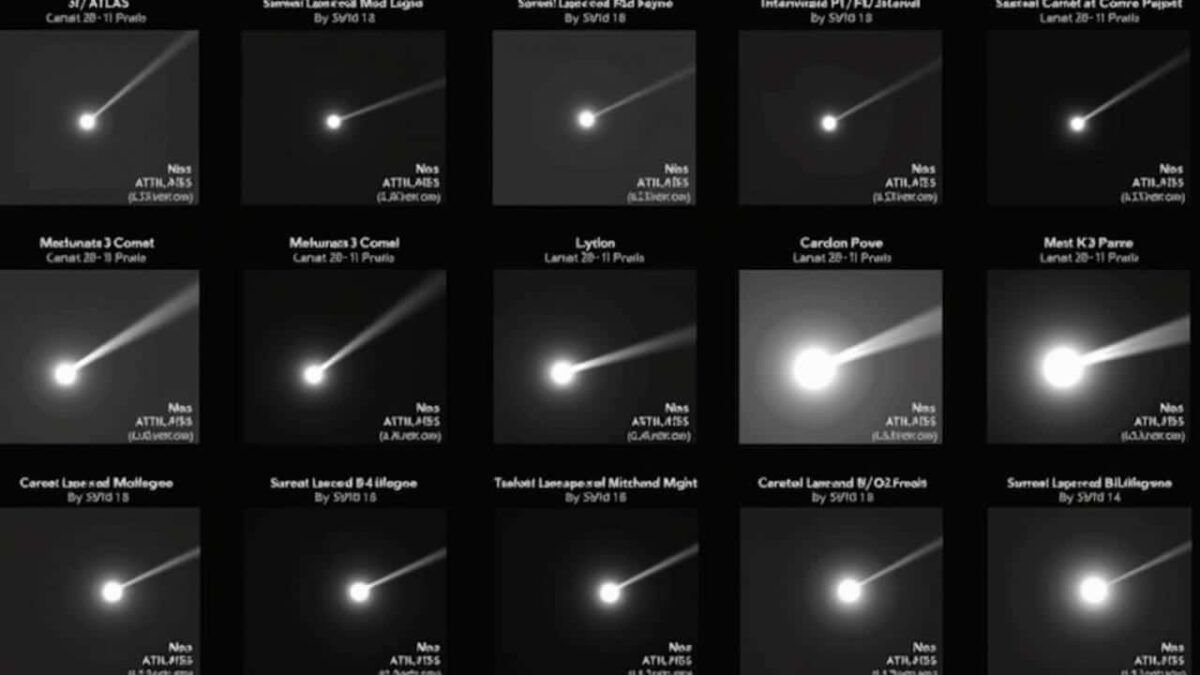
Imagine the electric atmosphere in a bustling observatory control room, where the first faint signals from the interstellar comet 3I/ATLAS flicker to life on high-resolution monitors. This elusive cosmic traveler, originating from beyond our Solar System, has captivated the global astronomy community with its rare passage. Thanks to the combined efforts of eight cutting-edge spacecraft, satellites, and telescopes, we’ve now released the most detailed images yet, offering unprecedented insights into this extraordinary visitor.
These stunning visuals go far beyond simple snapshots; they chronicle the comet’s dynamic changes as it interacts with our Sun’s intense radiation. From its icy core beginning to vaporize to the development of its ethereal tail, every image tells a story of interstellar migration. Astronomy enthusiasts and professionals alike are poring over this data, eager to decode the secrets carried from distant stars.
Unveiling the Mysteries of Interstellar Comet 3I/ATLAS
The interstellar comet 3I/ATLAS might not boast the dramatic flair of Hollywood comets, presenting instead as a subtle glow with a hazy envelope and a trailing tail. What truly distinguishes it is its extraterrestrial origin, having journeyed from the vast emptiness between stars into our Solar System. This makes it a priceless specimen for understanding planetary formation processes in other stellar systems.
Unlike objects bound to our Sun, 3I/ATLAS follows a hyperbolic orbit, a one-way trajectory that guarantees it won’t loop back. hurtling at speeds far exceeding typical Solar System bodies. This path confirms its outsider status, much like its predecessors ‘Oumuamua and 2I/Borisov, which sparked intense scientific debate with their unusual traits.
‘Oumuamua baffled experts with its elongated, cigar-like shape and unexpected acceleration without visible outgassing. In contrast, 2I/Borisov behaved more like a conventional comet but at interstellar velocities. 3I/ATLAS combines elements of both, featuring classic comet morphology infused with alien characteristics that challenge our models of cosmic evolution.
- Compact icy nucleus: A resilient core that holds together despite mounting solar heat.
- Delicate coma: A gaseous atmosphere forming as sublimating ices release jets of material.
- Expansive tail: Composed of dust particles and ionized gases, stretched across immense distances by solar wind pressures.
The sheer improbability of detecting 3I/ATLAS amid countless interstellar wanderers heightens its allure. Advanced survey technologies caught it at just the right moment, delivering a multi-angle visual archive that feels like peering into a time capsule from another star’s nursery.
The Global Collaboration Behind Eight Observatories
Capturing these images required seamless international teamwork, with astronomers coordinating across continents through instant communications and shared databases. Ground-based telescopes scrambled for optimal viewing windows under clear skies, while orbiting spacecraft and satellites realigned instruments for prime shots. This synchronized effort maximized data collection during the comet’s fleeting visit.
Each of the eight platforms brought specialized capabilities to the table, creating a rich tapestry of observations.
- Visible-light telescopes: Provided sharp details of the comet’s nucleus and surrounding coma structure.
- Infrared instruments: Revealed warm dust grains glowing in wavelengths beyond human vision.
- Ultraviolet sensors: Highlighted high-energy gas emissions and dynamic jet formations.
- Wide-field survey cameras: Documented the full extent of the tail against the cosmic backdrop.
Timing and Precision in Observations
Precision timing was key; some images snapped before perihelion showed a tightly packed form, while others post-passage hinted at emerging fragmentation. Dedicated night shifts, innovative processing algorithms, and even amateur contributions—like spotting a novel gas jet—elevated the dataset. This human-machine synergy transformed scattered pixels into a unified portrait of the comet’s metamorphosis.
By merging data across spectra, scientists construct a three-dimensional model of 3I/ATLAS, probing whether it’s a fragile aggregate or a monolithic ice body. Such collaborative feats set new benchmarks for tracking transient celestial events.
Decoding the Images: Insights from Pixels to Phenomena
These images are accessible even to newcomers—begin by identifying the brilliant central nucleus, gauging the coma’s breadth, and tracing the tail’s curvature. Such observations reveal the comet’s shedding of ancient ices under solar influence, painting a vivid narrative of transformation.
Deeper analysis uncovers chemical signatures: carbon-laden dust, exotic volatiles that either echo our own Oort Cloud comets or diverge strikingly. Time-lapse sequences show the coma bloating and tail distortions from magnetic interactions, offering clues to spin rates, erosion, and outgassing dynamics.
- Dust patterns: Illuminate the comet’s rotation and surface weathering history.
- Gas signatures: Hint at the natal environment around its parent star.
- Orbital deviations: Quantify the thrust from escaping vapors.
Broader Scientific Revelations
As a pristine relic from afar, 3I/ATLAS serves as a messenger, challenging assumptions about Solar System exceptionalism. Its composition informs theories on exoplanet debris and interstellar medium interactions, potentially reshaping our view of galaxy-wide material flows.
Implications for Future Cosmic Discoveries
The arrival of 3I/ATLAS reminds us of our place in a bustling interstellar highway, where seemingly ordinary objects embark on epic voyages. Freely shared online, these images ignite public wonder, bridging the gap between esoteric science and everyday curiosity.
With next-generation sky surveys and AI-driven detection, interstellar objects will transition from anomalies to routine study subjects. Enhanced telescopes and missions will intercept fainter, faster visitors, unlocking exoplanetary field dynamics. 3I/ATLAS paves the way for this golden age of exploration.
In summary, these latest images of the interstellar comet 3I/ATLAS capture a singular cosmic convergence, blending human ingenuity with universal serendipity. As the comet recedes into the void, it bequeaths invaluable knowledge, urging us to gaze upward. The universe teems with such stories—our vigilant watch promises endless revelations, fueling the eternal quest to understand our starry home.
What is the interstellar comet 3I/ATLAS?
How do we confirm it’s interstellar?
Why observe with eight different instruments?
Can amateurs spot 3I/ATLAS?
Will we find more interstellar objects?
