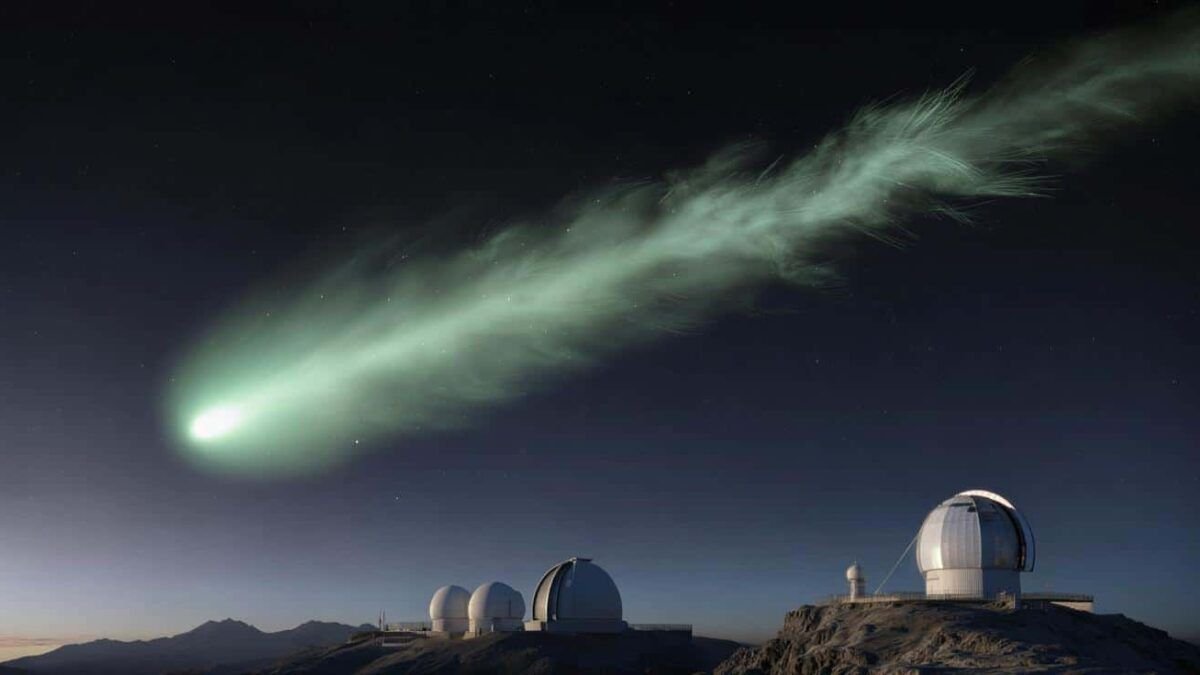
In the crisp predawn skies over Chile, astronomers held their breath as a mesmerizing emerald streak emerged on their monitors, cutting through the velvet darkness of space. This ghostly tail, frayed and luminous, belonged to the rare interstellar comet 3I ATLAS, a fleeting guest from beyond our Solar System. Captured by leading observatories worldwide, these spectacular new images offer a front-row seat to a cosmic spectacle, blending artistry with groundbreaking science.
From the volcanic heights of Mauna Kea in Hawaii to the rugged peaks of the Canary Islands, telescopes worldwide turned their gaze to this enigmatic traveler. These multi-perspective views, spanning various wavelengths, transform a distant blur into a detailed portrait of interstellar wanderlust. For stargazers and scientists alike, 3I ATLAS ignites wonder about the universe’s hidden highways.
Unveiling the Mysteries of Interstellar Comet 3I ATLAS
Designated as the third confirmed interstellar object to visit our cosmic backyard, 3I ATLAS stands out with its otherworldly allure. Recent images from elite facilities showcase a faint nucleus shrouded in a vibrant green coma, followed by an expansive, twisted tail stretching across millions of kilometers. Shaped by solar winds and radiation, this tail hints at the comet’s tumultuous journey from a far-flung star system.
Through the massive mirrors of the Very Large Telescope (VLT) in Chile, Gemini North in Hawaii, and the Gran Telescopio Canarias in Spain, astronomers reveal intricate textures. Subtle warps in the tail suggest influences from its long voyage, turning abstract data into vivid reality.
Key Features Captured in Ground-Based Imagery
Observers on La Palma described the thrill of the first sharp image appearing during standard scans. Ultraviolet shots from Hawaii uncovered a subtle gas envelope, while infrared data pointed to unusual dust grains not typical of Solar System comets. These findings evoke the magic of a meteor shower, but on a galactic scale.
The comet’s hyperbolic trajectory seals its extraterrestrial status—its speed defies solar gravity, marking it as a temporary intruder destined for the interstellar abyss. By analyzing tail bends, brightness shifts, and gas outflows, experts reconstruct its path from an ancient stellar nursery.
- Nucleus and Coma: A dim core wrapped in glowing gases, glowing emerald under specific filters.
- Tail Structure: Elongated and contorted, influenced by solar forces during perihelion approach.
- Exotic Composition: Dust and ices suggesting origins in a distant planetary system.
The Global Race to Image 3I ATLAS
The discovery began with Hawaii’s ATLAS survey, a network of robotic telescopes hunting for fast-moving sky objects. What started as a suspicious streak quickly revealed a hypervelocity path from deep space, triggering an international frenzy.
Observatories worldwide vied for observation time, coordinating across continents to maximize data collection. Teams juggled schedules, filters, and angles as the comet’s window of visibility narrowed rapidly.
- Gemini North pivoted from deep-space galaxies to track this interstellar speedster amid logistical excitement.
- VLT in Chile offered operators a rare moment to connect digital feeds with direct sky views.
- Gran Telescopio Canarias leveraged its high-altitude clarity for unparalleled tail details.
Real-time alerts, shared databases, and video calls bridged time zones, ensuring comprehensive coverage. This collaborative sprint not only yielded spectacular new images but also reignited passion among seasoned astronomers, merging rigorous research with pure awe.
Scientific Insights from Multi-Wavelength Views
Decoding the Comet’s Composition and Behavior
These images go beyond beauty, enabling precise orbital refinements and chemical breakdowns. Spectral analysis detects ices like water and carbon monoxide, plus potential exotic molecules from its home system.
Ongoing observations monitor activity surges near the Sun, revealing how heat triggers volatile releases. Such data illuminates the comet’s internal dynamics and evolutionary history.
Connecting Experts and the Public
For casual observers, the visuals make “interstellar” feel real, dispelling myths like alien tech behind the green glow—it’s ionized gases reacting to sunlight. Enhanced releases include annotations to guide interpretation.
- Details on imaging filters and standout features.
- Current sky location and solar proximity.
- Trends in motion, brightness, and structural changes.
- Unique contributions from each observatory.
- Open scientific questions for ongoing study.
As one expert from the European Southern Observatory put it, each interstellar comet acts as a “frozen messenger” from alien realms, carrying chemistry beyond our reach.
Broader Implications for Astronomy and Beyond
These captures help gauge the population of interstellar nomads, many likely overlooked before modern surveys. Clues about 3I ATLAS‘s origins—perhaps a shattered world or ejected fragment—emerge from its makeup.
Skywatchers gain a new lens: our Solar System as a cosmic crossroads, where galactic debris might mingle with local matter. Upcoming tools like the Vera C. Rubin Observatory will amplify detections, promising a surge in such events.
3I ATLAS underscores global teamwork in unraveling the universe’s web, prompting reflection on humanity’s stellar neighborhood.
Why Interstellar Comet 3I ATLAS Fascinates Everyone
Its scarcity fuels the hype—unlike bound comets, this one’s unbound path speaks of vast emptiness and lucky encounters. Imagine eons in the void, now dissected in mere weeks.
Annotated images boost public interest, tying into education on fluid cosmic boundaries and diverse materials. Surveys like ATLAS expand our cosmic inventory daily.
- Blurring lines between Solar System and interstellar space.
- Varied building blocks across the galaxy.
- The power of automated detection networks.
In essence, these spectacular new images of interstellar comet 3I ATLAS captivate by humanizing the immense. They remind us the night sky teems with tales from afar, beckoning professionals, hobbyists, and dreamers to look up. As 3I ATLAS recedes, its portraits endure, sparking the hunt for tomorrow’s interstellar wonders and affirming our shared quest to decode the cosmos.
Can I see interstellar comet 3I ATLAS with my own eyes?
How do astronomers confirm 3I ATLAS is interstellar?
What makes these new images of 3I ATLAS special?
Does 3I ATLAS pose risks to Earth?
Will more interstellar objects be found soon?
